France
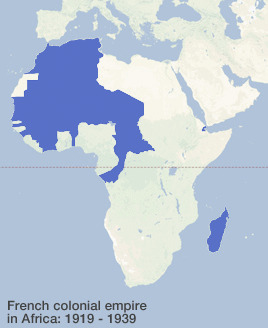
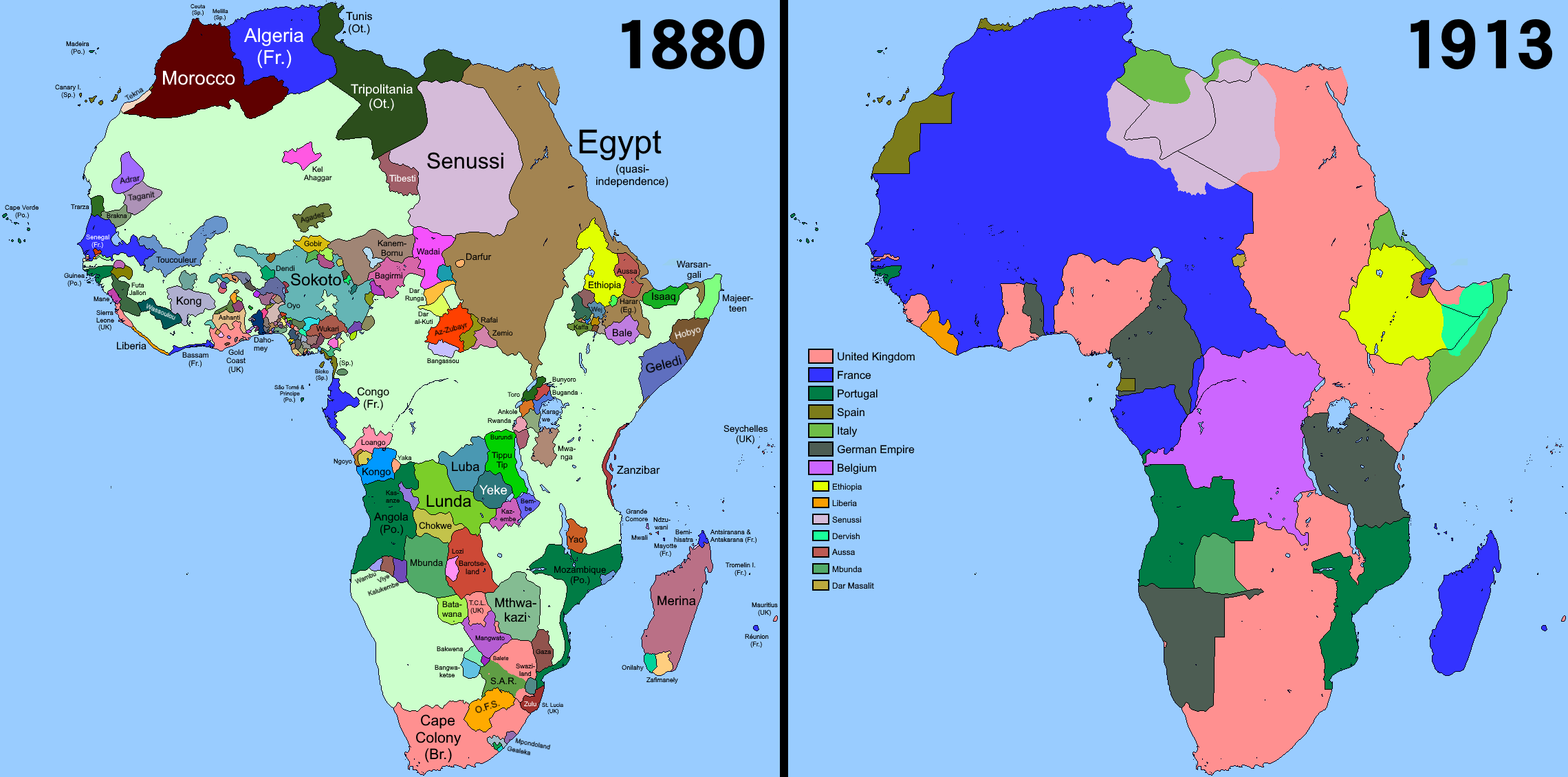
The largest colonial empire belonged to the French, the French controlled over 3 1⁄2 million square miles, half of which contained the Sahara Desert. In 1830, France had conquered Algeria in North Africa. France acquired Tunisia, Morocco, West Africa, and Equatorial Africa in 1881 and 1912. At its height, the French Empire in Africa was as large as the continental United States.
Great Britain
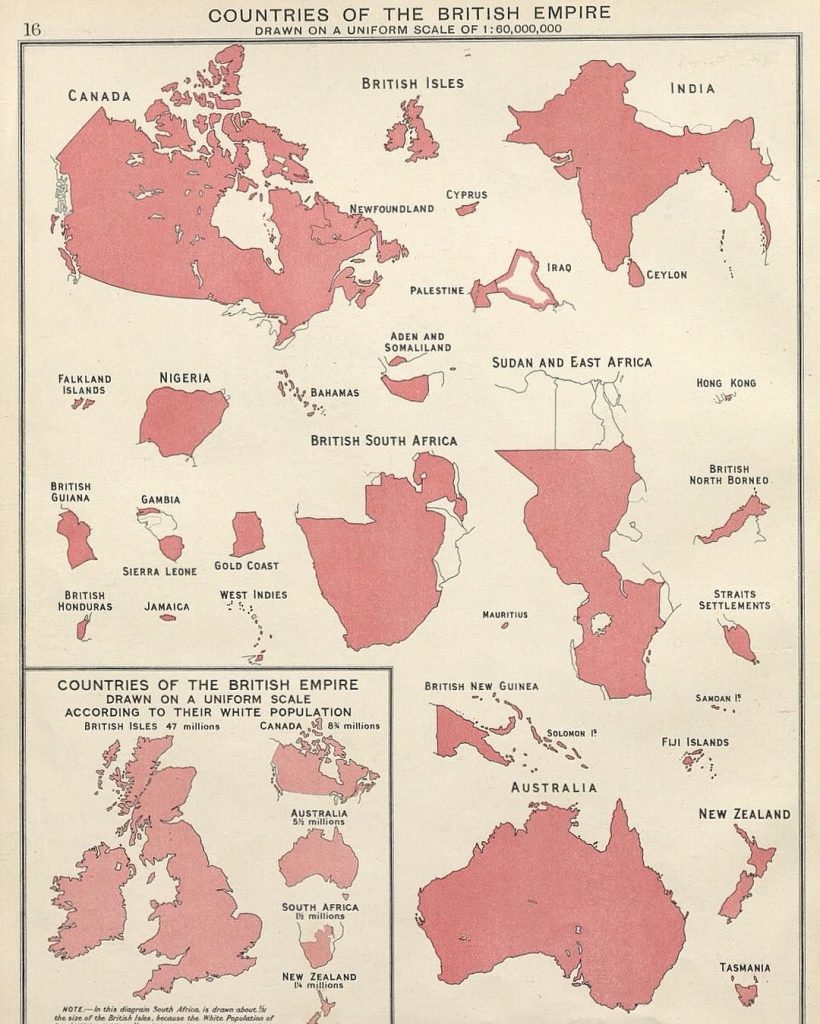
Britain controlled less land area than France, but the areas Britain did control were more populated, particularly South Africa, which contained valuable mineral resources such as diamonds and gold. In 1806, the British displaced Holland in South Africa and ruled the Cape Colony. However, the Boers (farmers), the original Dutch settlers who resented the British, came into conflict with the them. In the 1830s, the Boers left British territory, migrated north, and founded two republics—the Orange Free State and Transvaal. The Boers soon came into conflict with the powerful Zulus, a native-African ethnic group, for control of the land. When neither the Zulus and the Boers were able to win a decisive victory, the British became involved in The Zulu Wars and eventually destroyed the Zulu empire. In 1890, Cecil Rhodes (1853–1902), who was born in Great Britain and had become a diamond mine millionaire, became prime minister of the Cape Colony. He wanted Cape Town to Cairo to be an extension of the British African Empire and he decided to annex the Boer Republic. In the Boer War (1899–1902), the British, with great difficulty, defeated the Boers and annexed the Orange Free State and Transvaal. In 1910, Britain created the Union of South Africa by combining its South African colonies. White people ran the government, and the Boers, who outnumbered the British, assumed control. This system laid the foundation for racial segregation that would last until the 1990s.
By 1913, the British Empire held sway over 412 million people, 23% of the world population at the time, and by 1920, it covered 35.5 million km2 (13.7 million sq mi), 24% of the Earth's total land area.
Germany
Germany’s imperialistic ventures were delayed because of late unification, but Germany also wanted a portion of the power. Germany took land in eastern and southwestern Africa.
Italy
Another late entry into the imperialistic venture was Italy. Italy took control of Libya, Italian Somaliland, and the northernmost province of Ethiopia, Eritrea, near the Red Sea. Italy’s efforts to gain control of Ethiopia ended in bitter defeat.
Portugal
Large colonies in Angola and Mozambique were carved out by Portugal.
Spain
In 1898, Spain lost territories of land, including the Philippines, as well as Cuba and Puerto Rico, that is, the last of its colonies in the Americas. These events fundamentally shifted Spain’s place on the world stage and with them, most historians bring to a close their studies of Spanish imperialism. But the ‘Disaster of 1898’ did not end colonial engagement outright. Spain still possessed, as one contemporary put it, ‘a few inhospitable tiny islands in the gulf of Guinea, a few inches of the north Moroccan coast and half a dozen or so crags bearing the sinister name of outposts’.
Between 1912 and 1956, members of the Spanish monarchy, army, and political elite argued for a new era of imperialism in North Africa, which was realized with the creation of a protectorate in Morocco. In consolidating their foothold in North Africa, the Spanish precipitated a violent jihad, were forced to reconsider the state’s relationship to Muslim and Jewish communities, and became entangled in talks with Hitler about power politics in North Africa. Spain’s colonial activities in North Africa further helped/hindered the creation of ties with the emerging Arab nations of the post-WWII period.
India
After defeating the French in the Seven Years’ War (1756–1763), the British took control of India. The British controlled India through the British East India Company, which ruled with an iron hand. In 1857, an Indian revolt, led by native soldiers called sepoys, led to an uprising known as the Sepoy Mutiny. After suppressing the rebellion, the British government made India part of the empire in 1858. The British introduced social reforms, advocated education, and promoted technology. India was called the “Crown Jewel of the British Empire” because Britain profited greatly from it. The Indian masses, however, continued to live close to starvation and the British had little respect for the native Indian culture.
The Dutch held the Dutch East Indies and extended their control over Indonesia, while the French took over Indochina (Cambodia, Laos, and Vietnam). The Russians also got involved and extended their control over the area of Persia (Iran).
China
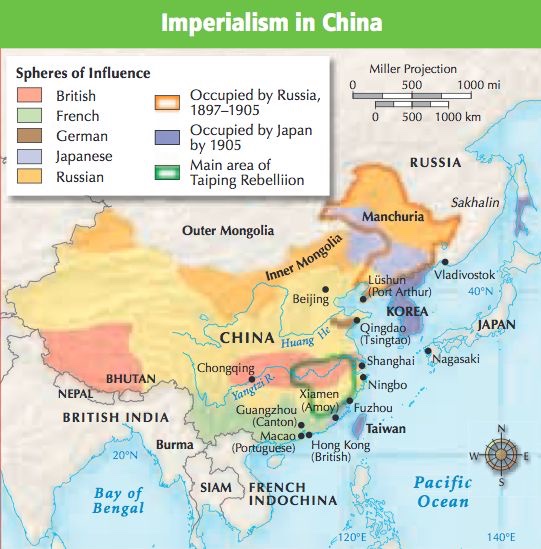
China had isolated itself from the rest of the world and refused to adopt Western ways since the seventeenth century. The Chinese permitted trade but only at the Port of Canton, where the rights of European merchants were at the whim of the emperor. Imperialism in China began with the First Opium War (1839–1842), when the Chinese government tried to halt the British from importing opium. This resulted in a war in which Britain’s superior military and industrial might easily destroyed the Chinese military forces. The Treaty of Nanking (1842) opened up five ports to the British, gave Britain the island of Hong Kong, and forced China to pay a large indemnity. In 1858, China was forced to open up eleven more treaty ports that granted special privileges, such as the right to trade with the interior of China and the right to supervise the Chinese customs offices. Foreigners also received the right of extraterritoriality, which meant that Western nations maintained their own courts in China and Westerners were tried in their own courts.
Between 1870 and 1914, the Western nations carved China into spheres of influence, areas in which outside powers claimed exclusive trading rights. France acquired territory in southwestern China, Germany gained the Shandong Peninsula in northern China, Russia obtained control of Manchuria and a leasehold over Port Arthur, and the British took control of the Yangzi valley. The United States, which had not taken part in carving up China because it feared that spheres of influence might hurt U.S. commerce, promoted the Open Door Policy in 1899. John Hay, the American Secretary of State, proposed that equal trading rights to China be allowed for all nations and that the territorial integrity of China be respected. The imperial nations accepted this policy in principle, but not always in practice. For the United States, however, the Open Door Policy became the cornerstone of its Chinese policy at the beginning of the twentieth century.
By the 1900s, China was in turmoil. China had been forced to give up so many political and economic rights which caused rising sentiment against foreigners. This anti-foreign sentiment exploded into the Boxer Rebellion or Uprising (1899–1901). The Boxers were a secret Chinese nationalist society supported by the Manchu government, and their goal was to drive out all foreigners and restore China to isolation. In June 1900, the Boxers launched a series of attacks against foreigners and Chinese Christians. They also attacked the foreign embassies in Beijing. The imperialistic powers sent an international force of 25,000 troops to crush the rebellion, which ended within two weeks.
The Boxer Rebellion failed, but it convinced the Chinese that reforms were necessary. In 1911, revolutions broke out across the country and the Manchu emperor was overthrown. Dr. Sun Yat-Sen (1866–1925), the father of modern China, proclaimed a republic and was named the new president. He advocated a three-point program of nationalism (freeing China from imperial control); democracy (elected government officials); and livelihood (adapting Western industrial and agricultural methods). The Chinese republic faced many problems and for the next thirty-seven years, China would continue to be at war with itself and with foreign invaders.
Japan
Japan was the only Asian country that did not become a victim of imperialism. In the seventeenth and eighteenth centuries, the Japanese expelled Europeans from Japan and closed Japanese ports to trade with the outside world, allowing only the Dutch to trade at Nagasaki. In 1853, an American naval officer, Commodore Matthew Perry (1866–1925), led an expedition to Japan. He convinced the shogun, a medieval-type ruler, to open ports for trade with the United States. Fearful of domination by foreign countries, Japan, unlike China, reversed its policy of isolation and began to modernize by borrowing from the West. The Meiji Restoration, which began in 1867, sought to replace the feudal rulers, or the shogun, and increase the power of the emperor. The goal was to make Japan strong enough to compete with the West. The new leaders strengthened the military and transformed Japan into an industrial society. The Japanese adopted a constitution based on the Prussian model with the emperor as the head. The government was not intended to promote democracy but to unite Japan and make it equal to the West. The leaders built up a modern army based on a draft and constructed a fleet of iron steamships.
The Japanese were so successful that they became an imperial power. In the Sino-Japanese War of 1894–95, Japan defeated China and forced her to give up her claims in Korea. Japan also gained control of its first colonies—Taiwan and the Pescadores Islands—and shocked the world by defeating Russia in the Russo-Japanese War of 1904–1905. Japan’s victory was the first time that an Asian country had defeated a European power in over 200 years.